

A comparative review of classical PDE5 inhibitors and alternative ED treatments versus the investigational agent simenafil (TPN171H).
Abstract
Erectile dysfunction (ED) affects hundreds of millions of men worldwide and is closely linked to cardiometabolic disease, aging, and psychosocial well-being. For more than two decades, oral phosphodiesterase-5 inhibitors (PDE5Is), such as sildenafil, tadalafil, vardenafil, and later avanafil, have dominated first-line ED therapy in all major international guidelines. Generic versions now offer extremely inexpensive and accessible treatment options. However, non-responders, dose-limiting adverse effects, and convenience issues continue to create unmet needs. Simenafil (also known as simmerafil, TPN171H) is a highly potent, highly selective, investigational PDE5 inhibitor with encouraging phase 1 pharmacokinetic data and a large phase 3 randomized trial in erectile dysfunction. This comparative review evaluates simenafil alongside established PDE5 inhibitors and alternative ED therapies, examining efficacy, onset and duration, safety, tolerability, patient convenience, market positioning, and potential cost-effectiveness. Since simenafil lacks head-to-head trials, all comparisons are indirect and must be interpreted with caution. Still, early evidence suggests areas where simenafil may eventually outperform classical agents, where it may fall short, and how it might integrate into an already saturated global PDE5 inhibitor market.
| Drug Name: | Sildenafil + Tadalafil + Vardenafil |
| Tablet Strength: | 20mg / 100mg |
| Price: | €0.38 Per Pill |
| Payment: | Visa, MasterCard, Btc |
| Where to Buy | 2Lyfe Rx |
Introduction
Epidemiology and burden of ED
Erectile dysfunction (ED) is one of the most common male sexual health complaints, affecting tens of millions of men worldwide. Prevalence rises sharply with age, but the condition is not limited to older populations: men in their 40s increasingly report difficulties, and by the age of 60 more than half experience some degree of ED. What makes ED especially significant is its tight link to systemic health. Rather than being an isolated sexual issue, it often reflects underlying endothelial dysfunction and is strongly associated with hypertension, diabetes, dyslipidemia, obesity, smoking, and metabolic syndrome. Multiple prospective studies show that ED frequently appears years before overt cardiovascular disease, giving clinicians a valuable early warning sign.
The psychosocial burden is equally substantial. Men with persistent ED describe reduced confidence, increased anxiety or depression, and strain within relationships. Partners, too, often feel excluded, confused, or rejected, leading to emotional distance or avoidance of intimacy. ED therefore disrupts both individual well-being and couple dynamics. Successful treatment has far-reaching impact: it improves functional sexual outcomes while restoring communication, emotional closeness, and a sense of normalcy.
Current treatment landscape
For more than two decades, oral phosphodiesterase-5 inhibitors (PDE5Is) have remained the core of ED therapy. Major international guidelines, including those from the European Association of Urology (EAU), the American Urological Association (AUA), the Princeton Consensus, and French AFU/SFMS, consistently designate PDE5Is as first-line pharmacologic treatment once cardiovascular risks are assessed.
Four agents define the established PDE5I class: sildenafil, tadalafil, vardenafil, and avanafil. They differ in onset, duration, selectivity, and food interactions, but share a common mechanism: enhancing the nitric-oxide–cGMP pathway to improve erectile response with sexual stimulation. Their convenience, safety, and familiarity explain why they have dominated the field for so long.
When these agents are insufficient or inappropriate, clinicians turn to second-line treatments. Alprostadil, administered via intracavernosal injection or intraurethral suppository, reliably induces erections but can be painful and is often perceived as invasive. Vacuum erection devices provide a mechanical option and remain valuable in post-prostatectomy rehabilitation. For severe, refractory ED, penile prosthesis implantation offers the highest satisfaction but is reserved for selected cases. Testosterone replacement is not a general ED therapy and is used only in confirmed hypogonadism, often to augment PDE5I responsiveness.
Rationale for developing new PDE5 inhibitors
Despite broad availability and the dramatic expansion of low-cost generics, unmet needs persist. Some men do not respond adequately even to maximally titrated PDE5Is. Others experience side effects, such as headache, flushing, nasal congestion, dyspepsia, or visual disturbances, that limit dose escalation or long-term adherence. Food interactions, timing constraints, and anxieties about whether the drug will “work in time” reduce spontaneity for many couples. For daily users, excessively long drug exposure can also be undesirable.
The pharmacokinetic profiles of existing drugs leave certain gaps. Sildenafil and vardenafil act for only a few hours and are strongly influenced by food, while tadalafil offers a remarkably long duration that some patients appreciate and others find excessive. Individual tolerability differences, particularly related to PDE6-mediated visual effects or PDE11-mediated muscle/back pain, further complicate real-world use. Although generics have improved global access, they also created a competitive market where innovation stalls unless a new agent can demonstrate clinically meaningful advantages. A next-generation PDE5 inhibitor must offer better selectivity, smoother pharmacokinetics, improved tolerability, or greater convenience to justify its place among entrenched, inexpensive alternatives.
Introducing simenafil (simmerafil, TPN171H)
Simenafil (also known as simmerafil or TPN171H) is an investigational PDE5 inhibitor under development for both erectile dysfunction and pulmonary arterial hypertension. It represents an attempt to refine PDE5 inhibition rather than redefine it. Early data portray simenafil as highly selective for PDE5, with limited activity on PDE6 and PDE11 – a biochemical profile that could translate to fewer visual disturbances and fewer muscle-related side effects.
Pharmacokinetic studies show rapid absorption with a Tmax around one hour and a half-life of roughly nine to ten hours, a range that positions simenafil between sildenafil’s shorter effect and tadalafil’s prolonged exposure. This intermediate half-life suggests a potential “evening-long” window of responsiveness without the next-day residual activity that some tadalafil users experience.
Clinically, simenafil has advanced through phase 1 studies and at least one large, multicentre phase 3 trial in erectile dysfunction. Trial results indicate significant improvements in IIEF-EF scores and sexual encounter profile responses across ED severities. Discontinuation rates appear low, and published safety data so far reveal no major cardiovascular warnings. Popular press coverage amplified early findings by describing simenafil as “ten times more potent than sildenafil,” referring to dose-for-dose comparative assays rather than clinical head-to-head evidence, which marks an important distinction.
Since the vast majority of existing data come from early-phase or regionally concentrated studies, simenafil must still be regarded as a promising but unproven addition to the PDE5I class. Nevertheless, its pharmacologic profile and phase 3 efficacy signal a potential niche within the market, particularly for men who need a more selective agent or an intermediate-duration option.
Methods: How simenafil will be compared with existing ED drugs
Scope
This review focuses primarily on oral pharmacologic therapies, because they represent the backbone of contemporary erectile dysfunction management and the therapeutic space in which simenafil will realistically compete if approved. The analysis centers on the four globally established PDE5 inhibitors: sildenafil, tadalafil, vardenafil, and avanafil, whose comparative clinical performance is supported by decades of trials and meta-analyses. A brief, more condensed look at region-specific or “second-wave” PDE5 inhibitors (udenafil, mirodenafil, lodenafil) is included to clarify how simenafil might perform in markets where these agents have niche or country-level prominence.
Non–PDE5 pharmacologic alternatives such as alprostadil (intracavernosal or intraurethral) and testosterone replacement therapy are addressed only briefly. Their mechanisms, administration routes, and patient populations differ substantially from those of orally administered PDE5 inhibitors, and simenafil is not expected to compete directly with them except in cases where oral therapy fails or is contraindicated. Nonetheless, their inclusion helps contextualize treatment sequencing and shows where simenafil may or may not shift clinical practice.
Comparison framework
To enable a coherent and meaningful evaluation of simenafil’s potential place in therapy, each PDE5 inhibitor along with simenafil itself is compared across a set of clinically relevant dimensions. These dimensions reflect the criteria clinicians commonly use when selecting an ED medication and the factors that most influence patient satisfaction, adherence, and real-world outcomes.
A central comparison point is efficacy, focusing on improvements in the International Index of Erectile Function–Erectile Function domain (IIEF-EF), responses to Sexual Encounter Profile questions (SEP2 and SEP3), and overall rates of successful intercourse attempts. These endpoints are widely used in ED trials and allow indirect cross-trial perspective even though direct head-to-head randomized controlled trials are lacking.
Pharmacokinetic factors, such as onset of action, time to peak, half-life, and the overall practical duration of effect, play a major role in patient convenience. The timing of sexual activity varies from patient to patient, and the optimal drug for one individual may be inconvenient or ineffective for another. The comparison includes considerations of food interactions, which can significantly impair absorption for certain agents, and whether the drug is suitable for on-demand use, once-daily use, or both.
Safety and tolerability are essential for comparing PDE5 inhibitors, as adverse effects often determine whether a patient continues therapy. While headaches, flushing, and dyspepsia occur across the class, visual disturbances linked to PDE6 inhibition and muscular discomfort associated with PDE11 inhibition differ considerably among agents. Drug–drug interactions, particularly those involving CYP3A4 metabolism, shape clinical suitability in patients taking antihypertensives, antifungals, HIV medications, or alpha-blockers.
Another key dimension is patient convenience, a concept broader than pharmacokinetics alone. It encompasses how predictable a drug’s effect is, whether it permits spontaneity or requires planning, how it integrates with meals, and how its duration influences next-day comfort or exposure. These factors contribute significantly to real-world preference—even when traditional efficacy measures appear similar across drugs.
Finally, cost and access are unavoidable considerations. The ED market is heavily shaped by generic sildenafil, especially low-cost sildenafil and tadalafil. Because these generics are so inexpensive and widely available, any new PDE5 inhibitor, simenafil included, will initially face a steep economic barrier. Guidelines, formulary rules, and patient willingness to pay will influence adoption, and these, too, vary globally.
Handling uncertainty
Simenafil currently lacks the robust, multi-regional trial portfolio enjoyed by first-generation agents. Most data stem from early-phase pharmacokinetic studies and one pivotal phase 3 randomized controlled trial, with a clinical population primarily drawn from Asia. This introduces several uncertainties. Cross-trial comparisons are inherently limited, as different studies employ varying inclusion criteria, placebo run-in designs, dosages, and endpoints. Even when two drugs appear to have similar improvements in IIEF-EF scores, differences in baseline severity, population characteristics, and cultural dynamics may influence outcome interpretation.
As a result, this review distinguishes clearly between data-driven conclusions and hypotheses. Claims about simenafil’s potential advantages, such as fewer visual side effects or more suitable intermediate-duration dosing, are grounded in available evidence but explicitly acknowledged as provisional pending direct head-to-head trials. Statements about market performance, cost competitiveness, or long-term patient preference are similarly framed as scenario-based projections rather than firm predictions.
Classical PDE5 inhibitors: concise profiles
This section provides focused profiles of the four major PDE5 inhibitors that currently dominate global erectile dysfunction therapy. Each subsection follows the same structure: an overview of the drug’s identity and role, a discussion of pharmacokinetics, an appraisal of efficacy and safety, notes on cost and access, and finally a brief reflection on what simenafil would need to surpass or meaningfully differentiate itself from the established agent. The aim is not to repeat textbook-level detail but to highlight clinically relevant features that shape patient experience and real-world usage.
Sildenafil
Sildenafil remains the most iconic treatment for erectile dysfunction and continues to serve as the global reference standard. As the first PDE5 inhibitor launched in 1998, it transformed ED from a stigmatized challenge into a treatable medical condition. Its pharmacokinetics define a short-acting, on-demand drug: it begins to work in roughly 30–60 minutes, though heavy meals can slow absorption, and its three- to five-hour half-life limits its therapeutic window to a single sexual event. Despite these constraints, its efficacy is remarkably consistent across etiologies, with many trials reporting improvements in erectile function in roughly 70–80% of men. Adverse effects such as headache, flushing, nasal congestion, and dyspepsia are common but predictable; the most distinctive issue is visual disturbance, usually blue-green color shifts or increased light sensitivity caused by PDE6 inhibition in retinal cells. These symptoms are usually mild but can trouble men with preexisting ocular sensitivity.
What maintains sildenafil’s unmatched popularity is its cost and accessibility. After losing patent protection, it became one of the least expensive ED medications in the world, available in many regions for cents per dose. Physicians know it well, and patients often request it by name. For simenafil to meaningfully outperform sildenafil, it would need to match or exceed its efficacy while offering advantages in tolerability or convenience, particularly by avoiding food interactions and visual side effects.
The greatest challenge, however, is economic: beating a drug that is globally cheap, familiar, and trusted will require a combination of clinical and experiential superiority rather than incremental improvement alone.
Tadalafil
Tadalafil occupies a distinct therapeutic niche because of its long duration of action and dual usability as both an on-demand and once-daily medication. Approved in 2003, it quickly earned the moniker “the weekend pill” thanks to its ~17.5-hour half-life and up to 36 hours of effect, allowing a wide window for sexual activity and a sense of spontaneity unmatched by other PDE5 inhibitors. Food interactions are minimal, giving tadalafil a smoother, more predictable onset regardless of meals. Its efficacy is well established and broadly equivalent to sildenafil, though its adverse-effect profile differs: back pain and myalgia occur in a subset of patients due to PDE11 inhibition, an off-target effect not prominent in the older short-acting agents.
Tadalafil’s popularity is strengthened by its once-daily regimen, which some men prefer for continuous readiness and convenience, and by its regulatory approval for benign prostatic hyperplasia, making it uniquely positioned at the intersection of sexual function and urinary symptoms. With widespread generics, its price has fallen significantly.
To compete with tadalafil, simenafil would need to balance flexibility with control, offering enough duration to support spontaneity but avoiding the next-day systemic exposure some patients dislike. It may also find an advantage if its high PDE5 selectivity leads to fewer muscular side effects. Pricing will influence adoption heavily, particularly in markets where daily tadalafil has become inexpensive and deeply integrated into clinical practice.
Vardenafil
Vardenafil, approved slightly after tadalafil, was initially framed as a refined analogue of sildenafil with greater PDE5 affinity and potentially tighter pharmacodynamic precision. In practice, however, its clinical performance aligns closely with sildenafil’s. Its onset occurs within 30–60 minutes, its four- to five-hour half-life supports a single-event window, and its effect may still be reduced by high-fat meals, making its real-world convenience similar to that of sildenafil. A distinctive caution is its potential to contribute to QT interval prolongation, a consideration particularly relevant for patients with cardiac vulnerabilities or those taking other QT-prolonging medications.
Although vardenafil is effective and well tolerated, it never achieved the global popularity of sildenafil or tadalafil, partly due to limited differentiation and partly due to timing of regulatory and commercial events. For simenafil, however, this may present an opportunity: if early observations about minimal food interactions and the absence of QT-related concerns are confirmed, simenafil could surpass vardenafil in both convenience and safety. Because vardenafil lacks a dominant market position, it represents a relatively achievable competitor compared with the more entrenched PDE5 inhibitors.
Avanafil
Avanafil is the newest of the globally approved PDE5 inhibitors and was developed with a central design objective: rapid onset. Many men experience effects in 10–30 minutes, and some achieve a functional response as early as 15 minutes. This rapidity is paired with a moderate half-life of roughly four to five hours, making avanafil primarily an on-demand agent with a smoother and more predictable pharmacokinetic curve than sildenafil or vardenafil. Its high PDE5 selectivity reduces the likelihood of visual side effects, and safety studies frequently note favorable tolerability profiles.
Despite its advantages, avanafil remains more expensive, as generics are not widely available. Its uptake varies significantly depending on insurance coverage and market conditions.
Avanafil’s main strengths, i.e., speed and selectivity, mean that simenafil must compete on different terrain. Simenafil’s predicted value lies not in ultra-rapid onset but in its intermediate duration, which may give men a broader window for intimacy without the prolonged exposure of tadalafil. If simenafil demonstrates smoother tolerability and competitive pricing, it could attract users who want more flexibility than sildenafil offers but do not need the exceptionally fast onset of avanafil.
Other PDE5 inhibitors
In addition to the globally dominant PDE5 inhibitors, several agents have achieved regional approval, including udenafil, mirodenafil, and lodenafil. These drugs were developed to offer intermediate half-lives and alternative tolerability profiles but have not gained broad international presence. Their clinical performance generally overlaps with existing agents, and none introduce dramatic innovation in mechanism or convenience. If simenafil secures broader global regulatory approval and demonstrates a distinctive balance of potency, selectivity, and duration, it may effectively out-position these region-specific competitors, especially in markets where pharmaceutical differentiation remains valued.
Non-PDE5 pharmacologic options
Although oral PDE5 inhibitors dominate the therapeutic landscape for erectile dysfunction, several non-PDE5 pharmacologic approaches remain clinically relevant, especially for men who do not respond adequately to oral agents or who cannot use them because of drug interactions or cardiovascular contraindications.
Alprostadil, available as either an intracavernosal injection or an intraurethral suppository (MUSE), is the most established second-line treatment. It works independently of nitric oxide pathways by directly relaxing penile smooth muscle through prostaglandin E1–mediated mechanisms. Its efficacy is high, particularly in men with severe neurogenic or vasculogenic ED, but its invasive nature limits patient acceptance. Intracavernosal administration produces strong, reliable erections but can cause penile pain, bruising, or fibrosis with long-term use. The intraurethral formulation avoids needles but is less potent and may cause urethral burning or discomfort. Despite these drawbacks, alprostadil remains indispensable for men who do not respond to oral PDE5 inhibitors.
Testosterone replacement therapy offers benefit only in cases of confirmed hypogonadism. Low testosterone alone is not typically sufficient to cause ED, but it can diminish libido and impair response to PDE5 inhibitors. For this reason, testosterone therapy is often used as an adjunct rather than a standalone ED treatment. When hypogonadism is appropriately diagnosed, testosterone replacement can meaningfully enhance sexual desire, improve energy levels, and restore responsiveness to PDE5Is in some men. However, it is not indicated for eugonadal men, and inappropriate use carries potential risks, including erythrocytosis, prostate-related concerns, and fertility suppression.
These therapies serve important roles, but their clinical niches are fundamentally different from the space in which simenafil will compete. Neither provides a true alternative to oral PDE5 inhibitors for the majority of men with ED. As a result, simenafil’s primary competition and its primary opportunity lies within the established PDE5 inhibitor class. Its success will depend on whether it can offer advantages in selectivity, tolerability, duration, or convenience, rather than on its ability to replace or outperform non-oral therapies that exist primarily for PDE5I non-responders.
Simenafil (TPN171H): Deep Dive
Molecular and pharmacologic profile
Simenafil (simmerafil, development code TPN171H) is a highly selective investigational PDE5 inhibitor developed with the explicit goal of refining the pharmacologic behavior of first-generation agents. Structurally, it belongs to a class of optimized pyrimidinone derivatives designed to achieve greater PDE5 affinity while minimizing off-target inhibition of PDE6 and PDE11. These enzymatic selectivity differences matter because they map onto clinically relevant side-effect domains—PDE6 with visual disturbances and PDE11 with muscle-related symptoms. Early biochemical assays suggest that simenafil’s PDE5/PDE6 and PDE5/PDE11 ratios are substantially higher than those of sildenafil or tadalafil, implying that the drug may produce fewer visual or muscular adverse effects.
The rationale behind developing simenafil stems from the recognition that the ED market, while saturated with generics, still contains important unmet needs. Many patients discontinue older agents because of side effects, inconsistent onset, or inconvenient pharmacokinetics. Simenafil’s developers aimed to create a molecule with improved tolerability and a more versatile pharmacokinetic profile, while maintaining robust pro-erectile efficacy.
Preclinical studies reported a potency several times greater than sildenafil when compared on equal molar concentrations, suggesting the possibility of clinically meaningful effects at much lower milligram doses. Although potency does not automatically equate to superiority, it offers potential advantages in formulation, tolerability, and manufacturing cost.
Pharmacokinetics
Pharmacokinetic studies across phase 1 trials demonstrate that simenafil is rapidly absorbed, reaching peak plasma concentrations (Tmax) typically within 0.7 to 1.5 hours. Absorption appears relatively consistent, with limited food effect, which is an important differentiator from sildenafil and vardenafil, both of which show significantly delayed absorption with high-fat meals.
Simenafil’s elimination half-life of approximately 9–10 hours places it in an intermediate category between short-acting PDE5 inhibitors (3–5 hours) and long-acting tadalafil (17–20 hours). This positioning may be clinically meaningful: the drug is expected to support a broad evening window of responsiveness without carrying forward the extensive next-day exposure that some patients dislike about tadalafil. The pharmacokinetic curve shows a smooth rise and a gradual decline, suggesting suitability for on-demand dosing and, potentially, once-daily regimens, though the latter will require more long-term safety data.
Phase 1 studies also indicate no major effects on color discrimination, reinforcing the hypothesis that high PDE5/PDE6 selectivity may translate into fewer vision-related side effects.
Clinical efficacy
Simenafil’s most important clinical data come from a large, multicentre, randomized, double-blind, placebo-controlled phase 3 trial involving approximately 700 men with mild, moderate, or severe erectile dysfunction. Over 12 weeks of treatment, simenafil demonstrated statistically significant improvements in IIEF-EF scores across all fixed doses tested. Improvements in SEP2 (“penetration success”) and SEP3 (“successful intercourse completion”) were also robust, indicating that simenafil enhances both the initiation and maintenance of erections.
Although no head-to-head trials with sildenafil or tadalafil exist, indirect cross-trial comparisons suggest that simenafil’s magnitude of improvement is at least comparable to established PDE5 inhibitors. Media coverage has emphasized that simenafil may be clinically effective at one-tenth the dose of sildenafil, a claim rooted in comparative potency studies rather than direct clinical competition. Still, the phase 3 dataset consistently suggests that simenafil is not inferior to traditional agents in short-term erectile function outcomes.
Importantly, response rates were similar across etiologies, including men with metabolic or vascular comorbidities, though subgroup numbers remain limited. Further research will be needed in more diverse populations and in severe or difficult-to-treat ED, such as post-prostatectomy cases.
Safety & tolerability
Across phase 1 and phase 3 studies, simenafil has been well tolerated, with adverse events primarily reflecting the typical PDE5 inhibitor class effects: headache, flushing, nasal congestion, and dyspepsia. Discontinuation due to adverse events was low, suggesting that patients generally tolerate the drug well.
Notably, early trials report no major cardiovascular concerns. Simenafil did not produce clinically significant QT prolongation in available datasets, nor were there signs of hemodynamic instability beyond what is expected for PDE5 inhibitors. Visual adverse effects appear uncommon, aligning with the drug’s pharmacologic selectivity; similarly, muscular complaints, often associated with PDE11 off-target activity, have not been prominent in clinical reports to date.
However, a number of critical uncertainties remain. Most clinical data are derived from Asian populations, and global generalizability has yet to be established. Long-term safety, particularly in daily dosing regimens, is not fully characterized. There is limited evidence in elderly patients with extensive comorbidities, a group that comprises a substantial portion of the real-world ED population. As with all investigational drugs, larger and more diverse datasets will be necessary to understand rare or delayed adverse events.
Potential differentiators
Simenafil’s potential advantages over established PDE5 inhibitors arise from its combination of high potency, high PDE5 selectivity, and an intermediate pharmacokinetic profile. Its potency means that therapeutic effects may be achievable at lower doses, which could translate to reduced systemic exposure and potentially fewer side effects. This may also reduce manufacturing costs per tablet, which could become important in long-term market positioning.
The drug’s half-life suggests a “best of both worlds” position between short- and long-acting agents: longer duration and greater flexibility than sildenafil, but without the prolonged systemic persistence associated with tadalafil. This could provide an attractive balance for men who value spontaneity but prefer not to carry the drug’s effects into the next day.
The absence of notable visual disturbances in early trials may make simenafil appealing to men who discontinued sildenafil or vardenafil due to PDE6-related symptoms. Likewise, if the low incidence of muscular discomfort is confirmed, simenafil could attract users who avoid tadalafil due to PDE11-associated back pain.
Nonetheless, these differentiators remain hypotheses pending head-to-head data. Without direct comparative trials, simenafil’s competitive position will depend on how reliably clinical experience mirrors biochemical predictions and whether real-world tolerability advantages prove large enough to justify its likely higher initial cost relative to generic PDE5 inhibitors.
Drug-by-drug comparisons: where simenafil may be better, worse, cheaper, more popular
Simenafil vs sildenafil
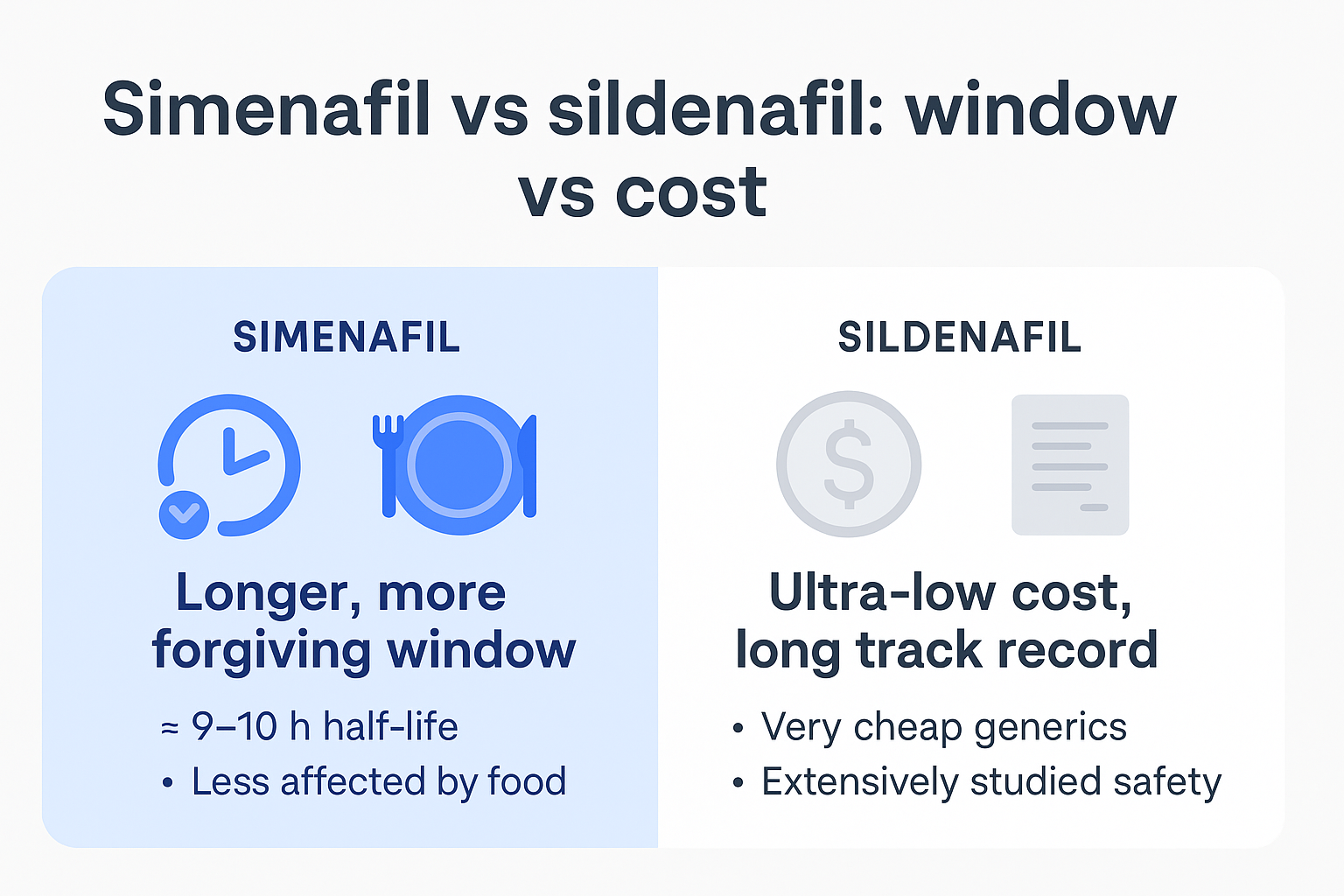 Sildenafil remains the global benchmark, so any new PDE5 inhibitor will inevitably be judged against it. The available evidence, primarily indirect cross-trial comparisons, suggests that simenafil’s efficacy is at least comparable. In the phase 3 ED trial, simenafil demonstrated robust improvements in IIEF-EF scores and positive SEP2/3 outcomes; these improvements appear similar to the magnitude historically observed with sildenafil, though methodological differences across trials preclude definitive superiority claims. Some preliminary analyses hint at slightly greater IIEF-EF gains with simenafil at a much lower dose, but until direct comparisons are performed, these remain intriguing rather than conclusive.
Where pharmacokinetics are concerned, the difference is clearer. Sildenafil’s onset varies, and its effect is strongly influenced by heavy meals, while its short half-life of three to five hours creates a narrow window of activity. Simenafil’s rapid absorption with limited food effect, combined with a nine- to ten-hour half-life, suggests a more forgiving therapeutic window. Men may find that they have more time to engage sexually without planning around meals or tight timing constraints. The trade-off is a longer systemic exposure, which may matter to patients who prefer very short-acting drugs.
In terms of tolerability, simenafil’s high selectivity gives rise to a reasonable hypothesis: it may cause fewer visual disturbances than sildenafil. Early phase 1 results showing no significant impact on color discrimination support this directionally, although much larger datasets will be needed. Headaches and flushing appear comparable across both agents. The safety landscape otherwise seems similar—sildenafil is well understood, whereas simenafil’s long-term profile is still emerging.
Pricing and access represent sildenafil’s largest advantage. With global generics available at extremely low cost, simenafil will debut at a higher price as a branded agent. Over time, if manufacturing efficiencies arising from simenafil’s lower required dose prove meaningful, it could become cost-competitive, but this is speculative. Popularity trends are equally uncertain. Sildenafil’s market position is deeply entrenched; simenafil’s success will depend on its ability to appeal to specific subgroups—for example, men bothered by visual effects, those who dislike sildenafil’s food interactions, or those who want a longer but not tadalafil-length window of activity.
| Drug | Key advantage |
|---|---|
| Simenafil | Longer, more forgiving window with limited food effect (≈9–10 h half-life). |
| Sildenafil | Extremely low generic price with a long, well-established safety record. |
Simenafil vs tadalafil
Tadalafil offers a unique value proposition: predictability, minimal food interaction, and an exceptionally long duration that supports spontaneous sexual activity over a day and a half. Its suitability for once-daily dosing and its approval for BPH further strengthen its clinical presence. Simenafil approaches this comparison from a different angle: it does not attempt to replicate tadalafil’s 36-hour window but instead offers a moderately long duration that may provide enough flexibility for an entire evening without carrying forward into the next day. For some men, this intermediate profile could be preferable, especially those who dislike tadalafil’s prolonged systemic exposure or experience next-day sensations such as flushing or facial warmth.
In terms of efficacy, the agents appear broadly comparable. Tadalafil’s real-world and trial data are extensive and show consistency across etiologies, including diabetes. Simenafil’s data are promising but limited in breadth. Without direct head-to-head comparison, at best one can suggest approximate similarity.
Safety profiles diverge more substantially. Tadalafil’s PDE11-related muscular symptoms, including back pain and myalgia, are well documented, though they affect only a subset of users. Simenafil’s early data do not show evidence of similar muscular effects, likely due to its different selectivity pattern. If confirmed in broader populations, this could represent a meaningful tolerability advantage.
Tadalafil’s price varies by region but is predominantly generic and affordable. Simenafil will struggle to displace tadalafil unless it provides either a compelling tolerability profile or a desirable pharmacokinetic alternative. Its intermediate half-life could serve as that differentiator for men who find tadalafil either too long-acting or too slow to clear. Popularity will likely depend on whether clinicians see simenafil as an attractive middle-duration option—something between the fast but brief agents and tadalafil’s prolonged coverage.
| Drug | Key advantage |
|---|---|
| Simenafil | Intermediate duration that covers an evening without carrying into the next day. |
| Tadalafil | Very long duration (up to ~36 h) and suitability for once-daily use, including in men with BPH. |
Simenafil vs vardenafil
Vardenafil offers efficacy comparable to sildenafil but adds certain limitations that have constrained its global adoption. A notable one is the potential for QT interval prolongation, which can influence prescribing in patients with cardiac concerns or those taking interacting medications. Its pharmacokinetic behavior, mainly onset and half-life, resembles sildenafil’s, including similar sensitivity to food-induced delays. Against this backdrop, simenafil’s more predictable absorption and lack of known QT-related issues create plausible reasons why it might be preferred.
Both drugs are effective, but vardenafil has never achieved strong market penetration. For simenafil, this may translate into a relatively accessible competitive space. If simenafil’s early tolerability advantages, particularly the absence of visual disturbances and a smoother onset, are confirmed, clinicians may view it as an updated alternative where vardenafil once fit.
Pricing may prove more influential here than with sildenafil or tadalafil, since vardenafil generics exist but are not universally cheap. If simenafil is competitively priced in some markets, it could outcompete vardenafil more quickly than the more dominant PDE5 inhibitors.
| Drug | Key advantage |
|---|---|
| Simenafil | More predictable pharmacokinetics without known QT-interval concerns and with a smoother onset. |
| Vardenafil | Available as generics in many markets, offering a familiar option for clinicians and patients. |
Simenafil vs avanafil
Avanafil is currently the fastest-acting PDE5 inhibitor and is marketed on that basis. Many men value the ability to take a tablet 15–30 minutes before sexual activity with high confidence that the effect will be timely. Simenafil does not aspire to ultrarapid onset; its strengths lie elsewhere. The comparison therefore creates a dichotomy between speed (avanafil) and duration (simenafil). In practical terms, simenafil’s nine- to ten-hour half-life may offer more flexibility for couples whose timing is uncertain or for those who prefer to avoid last-minute dosing. Conversely, patients who want an agent that acts quickly and clears relatively fast may continue to prefer avanafil.
Tolerability considerations offer a potential advantage for simenafil. Avanafil is already considered highly selective and generally well tolerated, but simenafil’s early data suggest even greater PDE5 specificity and a minimal visual side-effect burden. This could matter for men who experienced vision issues on sildenafil but want a drug with broader duration than avanafil. Still, avanafil’s speed is difficult to match, and simenafil’s appeal will lie in its longer, more forgiving activity window.
Both agents are likely to be priced as branded medications, at least initially. This means adoption will depend heavily on perceived clinical differences rather than cost. Simenafil may gain traction among users who find avanafil effective but too short-acting, or among clinicians seeking an interchangeable but longer-lasting alternative. However, unless simenafil demonstrates unexpectedly rapid onset in broader studies, avanafil will likely remain the preferred agent for those who prioritize speed above all.
| Drug | Key advantage |
|---|---|
| Simenafil | Longer duration of action (~9–10 h), providing more flexibility when timing is uncertain. |
| Avanafil | Fastest onset among PDE5 inhibitors, allowing dosing 15–30 minutes before intercourse. |
Simenafil vs regional PDE5Is and non-oral therapies
Region-specific PDE5 inhibitors such as udenafil, mirodenafil, and lodenafil occupy smaller markets and generally offer intermediate half-lives similar to the pharmacokinetic space where simenafil is positioned. Their limited differentiation has contributed to modest adoption internationally. Simenafil, by combining intermediate duration with improved potency and selectivity, may surpass these agents if approved broadly outside Asia, especially if it gains strong regulatory visibility or international marketing support.
Compared with non-oral therapies such as alprostadil or mechanical devices, simenafil’s position is clearly different. It is not intended to replace second-line therapies but rather to reinforce and expand the oral-therapy segment. Patients who require injections or devices will likely remain in those treatment paths regardless of simenafil’s performance. Conversely, simenafil may serve as a useful option for patients who respond to PDE5 inhibitors but find current agents inconvenient or poorly tolerated.
| Drug | Key advantage |
|---|---|
| Simenafil | Potent, highly selective PDE5 inhibition with an intermediate half-life and potential for broader international availability. |
| Regional PDE5Is (udenafil, mirodenafil, lodenafil) | Established use in specific markets and familiarity among local prescribers. |
Health-economic and market considerations
Erectile dysfunction therapeutics exist in a marketplace unlike most other pharmacologic domains. On one hand, demand is vast and stable; on the other, the core drug class has been generic for more than a decade, driving prices down dramatically and reshaping patient and clinician expectations. Any new PDE5 inhibitor—simenafil included—must therefore contend not only with clinical efficacy benchmarks but also with entrenched economic realities. This section examines simenafil’s potential position within that environment, considering cost per responder/cost per intercourse, access and reimbursement dynamics, and the complex, often unpredictable phenomenon of patient popularity.
Cost per responder/cost per intercourse
Economic assessments of ED therapy often rely on two practical metrics: cost per successful intercourse and cost per responder. These reflect real patient priorities and allow comparison across drugs that appear similar in efficacy but differ in duration, dosing regimen, or price. Existing analyses of sildenafil, tadalafil, vardenafil, and avanafil, such as those used by NICE and regional formulary bodies, typically show only modest differences in cost-effectiveness when drugs are priced similarly. Generic sildenafil and tadalafil dramatically distort this landscape, making them exceptionally economical per successful event.
Simenafil enters this environment as a branded medication, meaning its cost will exceed that of generics in the short term. However, the drug’s higher potency and lower milligram requirement could reduce manufacturing costs per tablet over time. If simenafil provides equal or improved efficacy with reduced adverse effects or better adherence, its cost per responder may be competitive even if the per-tablet price is higher. This becomes particularly relevant in daily dosing scenarios, where long-term tolerability and user satisfaction weigh heavily on adherence.
Cost-effectiveness will depend largely on whether simenafil’s intermediate half-life leads to more frequent successful intercourse per dose, especially for couples who prefer a flexible window rather than tightly timed dosing. A drug that reliably supports a full evening may require fewer repeat doses, thus narrowing the economic gap with generics in terms of cost per sexual event.
Access, reimbursement, regional constraints
Reimbursement landscapes for ED drugs differ strikingly by geography. In many countries, PDE5 inhibitors are considered lifestyle medications and are not routinely covered, which strongly favors very low-cost generics. In others, especially where ED is linked to chronic disease management, partial reimbursement is available for selected agents. Tadalafil’s BPH indication, for example, grants it access to formularies that exclude other PDE5 inhibitors.
Simenafil must navigate these restrictions without the advantage of a secondary therapeutic indication, unless future trials in pulmonary arterial hypertension expand its regulatory footprint. Early adoption will likely rely on niche patient groups: men who experience visual disturbances with sildenafil, those who find tadalafil too long-acting, or those who prefer a predictable yet not prolonged duration. Should these niches prove clinically significant, certain insurers may justify partial reimbursement for cases where cheaper generics are inadequate or poorly tolerated.
In publicly funded systems, decisions will hinge on whether simenafil offers clear incremental benefit. Health-technology assessments will require robust comparative data, which simenafil currently lacks. Thus, widespread reimbursement seems unlikely in the early years unless pricing is unexpectedly competitive or clinical evidence grows rapidly.
Hypotheses on anticipated popularity
Predicting popularity in the ED marketplace requires understanding that patient preference often outweighs pharmacologic nuance. Sildenafil’s cultural dominance stems as much from its brand identity as from its efficacy; tadalafil’s reputation is tied to spontaneity; avanafil markets itself as the fast-onset choice. Simenafil must find its own narrative. Its most likely position is that of an intermediate-duration, high-selectivity option, appealing particularly to men who want something longer and more forgiving than sildenafil but who do not want tadalafil’s prolonged systemic presence.
Early media coverage labeling simenafil as a “super-Viagra” may attract attention, but patient uptake will depend on real-world performance. If men perceive that simenafil provides smoother tolerability, fewer visual disturbances, or more flexibility in timing, it could rapidly gain a loyal user base. Clinicians may also favor it for patients sensitive to food interactions or for those who have partial responses to generic agents but wish to avoid injections or surgical options.
In high-income markets, early adopters, especially those familiar with ED pharmacotherapy, may drive initial uptake. In cost-sensitive regions, adoption will depend heavily on price reductions or timely entry of generics, which could take several years post-approval. Should simenafil eventually enter generic production, its low required dose could make it cost-competitive or even cheaper on a per-dose basis, potentially reshaping long-term market dynamics.
Overall, simenafil’s economic and market trajectory will hinge on two central questions: whether its clinical advantages prove meaningful enough to justify a higher initial price, and whether those advantages resonate with the lived experiences of patients and partners in real-world use.
Limitations
Any evaluation of simenafil’s potential must be weighed against the substantial limitations of the current evidence base. Although early data are promising, especially regarding selectivity, intermediate duration, and clinical efficacy in a large phase 3 trial, the picture remains incomplete in several important respects. These gaps shape not only what can be concluded today but also how cautiously claims about simenafil’s “advantages” must be framed.
The most significant limitation is the absence of direct head-to-head randomized controlled trials comparing simenafil to sildenafil, tadalafil, vardenafil, or avanafil. Without these studies, efficacy comparisons rely on cross-trial interpretation, which is inherently imprecise. Differences in study protocols, placebo run-ins, dosing schedules, patient demographics, baseline severity, and even cultural influences on sexual behavior all affect measured outcomes. A 2–3 point difference in IIEF-EF across unrelated trials may reflect design variation rather than genuine pharmacologic superiority. While pharmacokinetic and selectivity data provide biologically plausible reasons for differentiation, these hypotheses remain unconfirmed until rigorous comparative trials are conducted.
A second major limitation involves population diversity. Most clinical data for simenafil come from studies conducted in East Asian populations, predominantly Chinese cohorts. This is not unusual for early-stage development but raises questions about generalizability. PDE5 inhibitor response can vary with comorbidities, lifestyle factors, concurrent medications, and vascular health patterns that differ across regions. Populations in Western Europe or North America—often older, more sedentary, and more comorbid—may respond differently, especially in terms of tolerability and cardiovascular safety. Until simenafil is tested across more varied demographic groups, its global applicability remains uncertain.
Long-term safety is another area where evidence is still fragmentary. Phase 3 trials typically span 12 weeks, which is sufficient to characterize common adverse events but insufficient to detect rare risks or cumulative effects. For a medication that may be used chronically, sometimes daily, over many years, understanding the implications of long-term PDE5 inhibition, especially at lower but consistent plasma concentrations, is essential. Tadalafil—simenafil’s closest analogue in terms of potential daily use—benefited from extensive long-term observational data before achieving the clinical trust it now enjoys. Simenafil has not yet reached that stage.
There are also uncertainties around real-world drug–drug interactions. Although early PK studies show predictable metabolism and a likely CYP3A4 pathway similar to other PDE5 inhibitors, data remain limited. Patients with ED often take multiple medications, including antihypertensives, statins, glucose-lowering drugs, and antidepressants. Understanding how simenafil behaves in polypharmacy environments, especially in older men, will be essential for safe prescribing.
Economic and access considerations add additional layers of limitation. Any projections about cost-competitiveness, popularity, or reimbursement are speculative at this stage. Without knowing the eventual pricing strategy, manufacturing costs, payer negotiations, or country-level regulatory decisions, market forecasting can only be hypothetical. Even if simenafil proves clinically strong, its uptake will depend on how payers, pharmacies, and clinicians integrate it alongside low-cost generics.
Finally, media narratives describing simenafil as a “super-Viagra” create an expectation gap that may not align with clinical reality. While the drug appears promising, the enthusiasm of early coverage risks outpacing evidence, leading to misconceptions among patients and possibly clinicians. The scientific community must be cautious to avoid overstating benefits until more robust comparative data and long-term safety evidence are available.
The limitations surrounding simenafil are largely structural rather than negative: they reflect a drug early in its development lifecycle rather than one that has shown concerning signals. Nonetheless, these limitations constrain the certainty of current conclusions and underscore the need for further evidence before simenafil can be positioned confidently within the ED therapeutic landscape.
Conclusions and future directions
Simenafil (TPN171H) arrives at a moment when erectile dysfunction therapy is both deeply mature and still marked by persistent unmet needs. Two decades of PDE5 inhibitor use have demonstrated that the class is exceptionally effective for most men, yet real-world practice also shows that tolerability issues, food interactions, timing constraints, and overly long or overly short durations continue to shape patient experience. Against this backdrop, simenafil represents an effort not to reinvent ED therapy but to refine the pharmacologic profile that determines convenience, comfort, and adherence.
The evidence available so far (Phase 1 pharmacokinetics and Phase 3 efficacy and safety data) suggests that simenafil is strongly positioned as a next-generation PDE5 inhibitor. Its high PDE5 selectivity may reduce the incidence of visual disturbances and muscle pain; its intermediate half-life offers a pharmacokinetic niche between sildenafil’s brevity and tadalafil’s prolonged exposure; and its low-dose potency hints at potential advantages in tolerability and manufacturing cost. Clinical findings show meaningful improvements in erectile function, with response rates comparable to those of established agents, and safety data reveal no major cardiovascular or ocular concerns in early trials.
Yet these advantages remain promising rather than proven. Simenafil’s evidence base is limited by the absence of direct comparative trials with sildenafil, tadalafil, vardenafil, or avanafil. Cross-trial comparisons, though informative, cannot definitively establish superiority or even non-inferiority. Long-term safety, particularly in older men with comorbidities and polypharmacy, remains largely unexplored. The predominance of Asian clinical cohorts limits generalizability, and global variation in ED etiology, lifestyle, and comorbid disease could influence outcomes once the drug enters broader populations.
From an economic and market perspective, simenafil faces an uphill climb in a field dominated by very low-cost generics. The drug’s success will depend on whether its potential clinical advantages prove meaningful enough to justify a higher branded price. Early adopters may be drawn by the drug’s intermediate duration, smoother tolerability, or its positioning as a flexible “evening-long” option. In the longer term, if simenafil enters generic production and retains cost-efficient dosing, it may become competitive even in cost-sensitive markets. However, these scenarios remain speculative until pricing, reimbursement positions, and real-world performance become clearer.
Future research will determine whether simenafil earns a place alongside or even ahead of the established PDE5 inhibitors. Three lines of investigation are particularly important:
- Head-to-head randomized controlled trials comparing simenafil directly with sildenafil and tadalafil. These studies would clarify relative efficacy, onset, patient preference, and tolerability, particularly in subpopulations with known challenges on existing agents.
- Long-term safety and cardiovascular monitoring, especially for daily or frequent use. Understanding how simenafil performs in older men with diabetes, hypertension, or atherosclerotic disease will be essential for ensuring safe, widespread adoption.
- Trials in difficult-to-treat populations, such as men with post-prostatectomy ED, severe vasculogenic dysfunction, or inadequate response to first-line PDE5 inhibitors. If simenafil demonstrates consistent benefit in these groups, it could justify premium positioning and broader clinical enthusiasm.
In conclusion, simenafil stands as a highly promising incremental innovation within a mature therapeutic class. It is too early to claim that it will reshape the ED market, but its profile suggests genuine potential to improve the experience of men who find existing agents inconvenient or poorly tolerated. Its future will depend on rigorous comparative evidence, long-term safety confirmation, and pragmatic considerations of cost and accessibility. If these align favorably, simenafil may well become an important new option in the global management of erectile dysfunction, refining, rather than revolutionizing, a class that has already transformed the lives of millions.
References
- European Association of Urology. (2024). Management of erectile dysfunction (EAU Sexual and Reproductive Health Guidelines). https://uroweb.org/guidelines/sexual-and-reproductive-health/chapter/management-of-erectile-dysfunction
- Grellmann, J. M., et al. (2024). Therapeutic management of erectile dysfunction – AFU/SFMS guidance 2024. Progress in Urology. https://pubmed.ncbi.nlm.nih.gov/39645150/
- Khera, M., & Goldstein, I. (2020). AUA guideline on erectile dysfunction. Journal of Urology, 204(4), 809–817. https://www.auajournals.org/doi/full/10.1097/JU.0000000000003020
- Koskimäki, J., et al. (2021). Systematic review of PDE5 inhibitor efficacy and safety. Frontiers in Pharmacology, 12, 735708. https://www.frontiersin.org/articles/10.3389/fphar.2021.735708/full
- Yafi, F. A., & Albersen, M. (2023). Evolving medical management of erectile dysfunction: A narrative review. Sexual Medicine Reviews, 13(4), 513–529. https://academic.oup.com/smr/article/13/4/513/8221489
- Evans, J. D., Hill, S. R., & Dijk, D.-J. (2015). Comparison of available phosphodiesterase-5 inhibitors. Clinical Pharmacology: Advances and Applications, 7, 63–73. https://pmc.ncbi.nlm.nih.gov/articles/PMC4542406/
- Porst, H., et al. (2015). Meta-analysis of efficacy and safety of PDE5 inhibitors. European Urology, 68(4), 646–658. https://www.europeanurology.com/article/S0302-2838(15)00250-X/fulltext
- Chung, E. (2017). Comparative real-world effectiveness of PDE5 inhibitors in >130,000 men. International Journal of Clinical Practice, 71(9), e12950. https://www.sciencedirect.com/science/article/pii/S1743609517300387
- Guo, Y., et al. (2019). Sildenafil in erectile dysfunction: ASSESS-3 study. ResearchGate. https://www.researchgate.net/publication/336802040_Sildenafil_Assess-3_study_Randomized_Controlled_Clinical_Trial
- Porst, H., et al. (2005). Tadalafil once-daily vs. on-demand: Efficacy and safety. Journal of Urology, 174(6), 2050–2055. https://www.auajournals.org/doi/10.1016/j.juro.2003.12.005
- Goldstein, I., et al. (2012). Avanafil for erectile dysfunction: Registration and dose-ranging data. Journal of Sexual Medicine, 9(2), 488–499. https://www.sciencedirect.com/science/article/pii/S2050052114000663
- Kobori, Y., et al. (2023). Avanafil vs sildenafil in Japanese men with ED. International Journal of Urology, 30(2), 112–119. https://onlinelibrary.wiley.com/doi/10.1111/iju.14785
- UroToday. (2017). Avanafil versus sildenafil in spinal cord injury patients. https://www.urotoday.com/recent-abstracts/sexual-health/erectile-dysfunction/96289
- Qian, H., Zhang, Z., Chen, H., et al. (2021). Pharmacokinetics and safety of TPN171H in healthy volunteers. Frontiers in Pharmacology, 12, 735708. https://pubmed.ncbi.nlm.nih.gov/34262260/
- Qian, H., Zhang, Z., Chen, H., et al. (2022). Pharmacokinetics of TPN171H: Full-text clinical data. Frontiers in Pharmacology, 12, 735708. https://pmc.ncbi.nlm.nih.gov/articles/PMC9813128/
- Synapse. (2025). TPN171H: Clinical pharmacology and PK in renal/hepatic impairment. https://synapse.patsnap.com/drug/TPN171H
- Zhang, R., Liu, Y., & Chen, X. (2025). Simenafil (TPN171H) in erectile dysfunction: A phase 3 randomized trial. Journal of Sexual Medicine, 22(8). https://academic.oup.com/jsm/issue/22/8
- Zhang, R., Liu, Y., & Chen, X. (2024). Phase 3 trial: PK and safety of simenafil. PubMed. https://pubmed.ncbi.nlm.nih.gov/40624775/
- Wikipedia. (2025). Simmerafil. https://en.wikipedia.org/wiki/Simmerafil
- NICE. (2014). Avanafil for erectile dysfunction: Evidence summary. https://www.nice.org.uk/advice/esnm21/chapter/Key-points-from-the-evidence
- UroToday. (2025). AFU/SFMS systematic review: Oral ED drugs and patient preference. https://www.urotoday.com/index.php?option=com_content&id=162953
- Jannini, E. A., et al. (2015). Patient preference among PDE5 inhibitors. ResearchGate. https://www.researchgate.net/publication/276293824_Patient_preference_among_PDE5_is
- Data Bridge Market Research. (2023). Sildenafil and next-generation PDE5 inhibitors market analysis. https://www.databridgemarketresearch.com/reports/global-sildenafil-market
- The Sun. (2024). New pill “simenafil” branded a “super-Viagra” due to potency claims. https://www.thesun.co.uk/health/35913384/new-erectile-dysfunction-pill-simenafil-viagra/

